
The Real Cost of 7 Hours of Screen Time
By John, ScreenBuddy Founder
Seven hours of daily screen time doesn't just cost you time. It costs focus, motivation, mental clarity, and presence in your actual life. At 7 hours a day, you're spending over 2,500 hours per year on your phone. That's 106 full days, or roughly 3.5 months of waking hours annually. But the hidden costs, the ones you don't see on your Screen Time report, are often worse than the hours themselves.
KEY TAKEAWAYS
7 hours of daily screen time equals 2,555 hours per year, or about 106 full days
The time cost is only part of it. High screen time also drains focus, motivation, and mental energy
Excessive scrolling creates mental fog and makes it hard to concentrate on anything for more than 10-15 minutes
Motivation drops across the board: workouts feel harder, walks feel less rewarding, social situations feel like effort
Reducing screen time leads to better focus, less anxiety, and more engagement with life
The benefits compound: less screen time creates space for better habits like reading, exercise, and being present
The Time Math
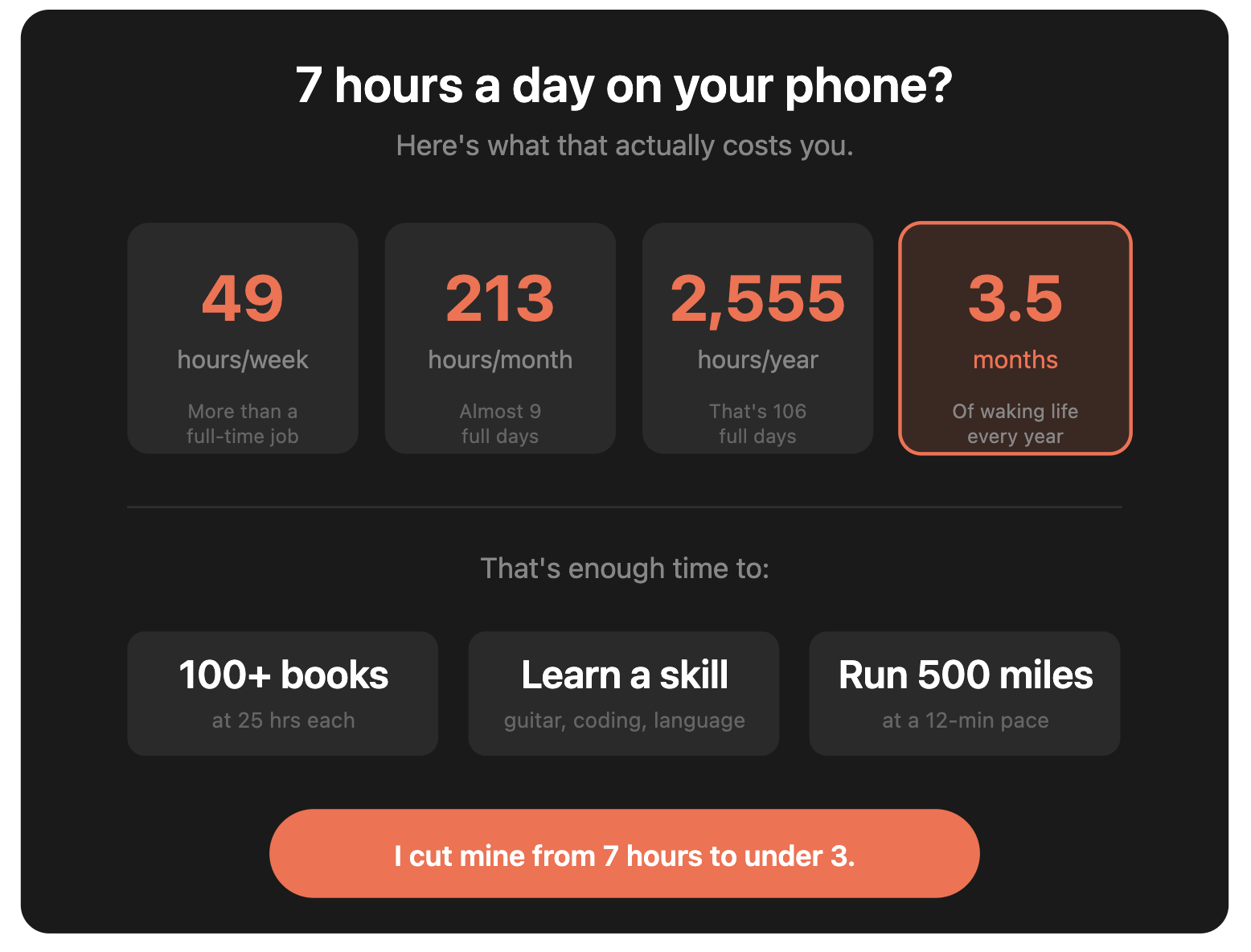
7 hours of daily phone use equals 49 hours per week, 213 hours per month, 2,555 hours per year, and 3.5 months of waking life annually
Let's start with the obvious cost: time.
At 7 hours per day, you're spending:
49 hours per week (more than a full-time job)
213 hours per month
2,555 hours per year
That's 106 days. If you sleep 8 hours a night, that's 3.5 months of your waking life, every year, spent on your phone.
Think about what you could do with 2,500 extra hours. Learn a skill. Build a side project. Read 50 books. Train for a marathon. Spend meaningful time with people you care about.
At 7 hours daily, those things feel impossible. You "never have time." But the time exists. It's just going somewhere else.
The Focus Cost
Time is the visible cost. Focus is the hidden one.
When I was at 7 hours daily, I couldn't concentrate on anything for a steady amount of time. Even 10-15 minutes into a task, I'd feel a pull to my phone. It didn't matter if the task was important. It didn't matter if I was interested in it. The urge to check was constant.
This is what high screen time does to your brain. It trains you to expect stimulation every few seconds. When you try to do something that requires sustained attention, your brain rebels. It wants the dopamine hit it's used to getting.
The result: work takes longer, quality suffers, and you feel mentally exhausted even when you haven't accomplished much.
The Motivation Cost
Here's something I didn't expect: high screen time killed my motivation for everything else.
When my screen time was high, I'd get less out of going for walks. Going to the gym felt harder. Being social felt like effort. It's easy to sit and scroll. Everything else requires activation energy that you don't have when your brain is already drained from hours of passive consumption.
This creates a cycle. You scroll because you're unmotivated. Scrolling makes you more unmotivated. So you scroll more.
The things that actually make you feel good, exercise, socializing, creating, being outside, all feel like too much work when your brain is fried from screen time.
The Mental Clarity Cost
At 7 hours daily, my brain was noisy. Mental fog. So many random thoughts. It was hard to think clearly or sit still without feeling restless.
I didn't fully realize this until I reduced my screen time and the fog lifted. The contrast was striking. Less noise. Fewer racing thoughts. More ability to be present without my mind constantly pulling me somewhere else.
This is maybe the hardest cost to quantify, but it's one of the most real. High screen time doesn't just take your time and focus. It takes your mental peace.
What Changes When You Cut Back
When I got my screen time from 7 hours to under 3, a lot shifted:
Better focus. I can concentrate on tasks without feeling the constant pull to check my phone. Work is more productive and less draining.
Less anxiety. My overall anxiety came way down. Less mental noise, fewer random thoughts, more calm.
More engagement. I'm more present in conversations. I actually enjoy being social instead of it feeling like effort.
Better habits. I read more. Work out more. I've built a habit of no phone for the first 20 minutes of my day. These habits compound on each other.
More motivation. The things that used to feel like effort, walks, gym, being social, now feel rewarding again. I'm not starting from an energy deficit every day.
The shift didn't happen overnight. It took consistent effort over weeks. But looking back, the 7-hour version of my life feels like a fog I didn't know I was living in.
How to Start
You don't need to go from 7 hours to 3 hours immediately. Start with one change:
Track your usage. Look at your Screen Time report. Know where the hours are actually going.
Pick your worst app. Identify the one app that eats the most time. Focus there first.
Add friction. Use a tool like ScreenBuddy to add a pause before your problem apps open. The 25-second countdown breaks the autopilot and makes you decide if you actually want to scroll.
Set a daily limit. Give yourself a budget. Even cutting from 7 hours to 5 is progress. Build from there.
The goal isn't perfection. It's awareness and gradual improvement.
Bottom Line
Seven hours of daily screen time costs you more than 100 days per year. But the real costs, the focus, motivation, mental clarity, and presence you lose, are harder to see and harder to get back.
Reducing screen time won't solve every problem in your life. But it creates space for the things that actually matter. For strategies to start cutting back, check out our complete guide on how to stop doomscrolling.
